Sunday, October 21, 2007

After This, by Alice McDermott


After This is a beautifully written book. It begins and ends in a church, and takes us from the marriage of Mary, a 30-year-old woman, through the birth and growth to adulthood of the four children she has with her husband John. The working-class family lives on Long Island during the middle-to-late decades of the twentieth century, riding out the storms of change in the culture, their lives, and in their church.

Although religion is a big part of their lives, I wouldn't call this a "religious" book. Rather, McDermott shows how the church and the family's beliefs affect - or do not affect - how they live. Mary in particular takes her church's teachings to heart, lighting candles during the two wars she experiences, attending mass regularly, insisting that the children attend Catholic school. We watch, too, as John lies in bed with a slipped disk, thinking of how his life might end, how it might not be as he had imagined, in bed, tended by a priest, but may be as unexpected as falling down dead in the street.

We see segments of each family member's life in vivid color, with light sketches in between phases. Thus we are treated to details of a dinner conversation or a night with a lover and then we may not hear much of that person until he or she is much older. Yet it works. I didn't feel cheated. Many of the moments are deeply moving by themselves, the more so because the moment is not over-labored.

I couldn't help comparing this book to a couple I read recently by Anne Tyler, both of which covered much of the same era in our history. Tyler's books seem, to me, more mocking, more like throwing a veil between the writer and the subjects, while After This is more intimate and touching.

And what is "after this"? From early on I suspected it was "after life". What then? After all that Mary and her family has done and gone through, what then?

Tuesday, October 16, 2007

Eight down, four to go

More to keep myself straight than for any other reason, I am reporting that I have read eight of the twelve I committed to reading. I am well into the ninth and partly into the tenth (I always read more than one book at a time) so I believe I will reach my goal!

I think this challenge has been excellent because the books are not just anything you happen to like. These are all good books and worth our time.

The Collected Stories by Amy Hempel

This book is Amy Hempel’s life work. Of course there is the odd story here and there that did not get in here but essentially this is it. In 404 pages she tells her own story in the form of short fiction, 49 stories in all. Most are shorter than most short fiction, one consisting of just one sentence and another just one page.

In this way, and in the language itself, these stories are much like poetry. All of them distill moments and thoughts economically, making much out of few words. Character is sketched in a phrase, and that’s all that is needed. Because of this depth it may take longer to read these seemingly simple stories than you might expect.

The elements also repeat themselves in a way similar to the film “32 short films about Glenn Gould”. We read about the lover of an artist, an artist who perhaps has many lovers. We hear about time in an institution. We read about dogs and cemeteries. Not once but many times, slid in between lines or used as the whole, layers or whole pies. I am sure that these elements come from Hempel’s real life, although the incidents probably did not happen to her exactly as written. In their way, skewed or direct, they tell us about this writer and the way she sees. It’s a beautifully-written book, full of images and feelings.

**Note to members of this group: If you would like to have this book contact me (judith at judithlautner dot net). I have registered it with bookcrossing.com so all I ask is that you make a journal entry there when you receive it (and preferably when you've read it, too). I'll be happy to ship it to the first person who asks, for free (outside the U.S. I'd want to split the postage).

Sunday, October 7, 2007

Laura's Challenge Wrap-up

The New York Times Notable Books Challenge was one of the first I joined this year, egged on by challenge host Wendy (aka Caribousmom). I was a little embarrassed that I'd heard of so few of these notable books, and set about to correct that by reading a dozen of them. The books I read for this challenge were:
  1. Black Swan Green, by David Mitchell (read in 2006)
  2. The Inheritance of Loss, by Kiran Desai
  3. Suite Francaise, by Irene Nemirovsky
  4. Half of a Yellow Sun, by Chimamanda Ngozi Adichie (completed 3/26/07)
  5. Old Filth, by Jane Gardam (completed 3/31/07)
  6. Beasts of No Nation, by Uzodinma Iweala (completed 4/13/07)
  7. One Good Turn, by Kate Atkinson (completed 5/25/07)
  8. The Translator, by Leila Aboulela (completed 5/28/07)
  9. Alentejo Blue, by Monica Ali (completed 6/17/07)
  10. Gate of the Sun, by Elias Khoury (completed 7/25/07)
  11. Arthur & George, by Julian Barnes (completed 8/26/07)
  12. The Road, by Cormac McCarthy (completed 9/2/07)
  13. A Woman in Jerusalem, by A.B. Yehoshua (completed 10/7/07)

Favorite Book of the Challenge: This is a real toss-up. I enjoyed Suite Francaise, Half of a Yellow Sun, and The Road the most.

Least Favorite Book: One Good Turn. This crime mystery was a pretty light read compared to the others on this list.

What I learned through this challenge: Every one of these authors was also new to me, and many of them are from outside the United States. This challenge really opened my eyes to the wealth of great literature in the world, and has inspired me to continue seek out authors from around the world.

Laura's Progress Report & List

Here's my list!

    Completed (with links to reviews):

    1. Black Swan Green, by David Mitchell (read in 2006)
    2. The Inheritance of Loss, by Kiran Desai
    3. Suite Francaise, by Irene Nemirovsky
    4. Half of a Yellow Sun, by Chimamanda Ngozi Adichie (completed 3/26/07)
    5. Old Filth, by Jane Gardam (completed 3/31/07)
    6. Beasts of No Nation, by Uzodinma Iweala (completed 4/13/07)
    7. One Good Turn, by Kate Atkinson (completed 5/25/07)
    8. The Translator, by Leila Aboulela (completed 5/28/07)
    9. Alentejo Blue, by Monica Ali (completed 6/17/07)
    10. Gate of the Sun, by Elias Khoury (completed 7/25/07)
    11. Arthur & George, by Julian Barnes (completed 8/26/07
    12. The Road, by Cormac McCarthy (completed 9/2/07)
    13. A Woman in Jerusalem, by A.B. Yehoshua (completed 10/7/07)

    Laura's Review - A Woman in Jerusalem


    A Woman in Jerusalem
    A. B. Yehoshua
    236 pages

    First sentence: Even though the manager of the human resources division had not sought such a mission, now, in the softly radiant morning, he grasped its unexpected significance.

    Reflections: An anonymous woman is killed in a terrorist attack in Jerusalem, and her body lies unidentified and unclaimed. A recent pay stub is found among her belongings, and a news weekly publishes an article, calling the company uncaring and negligent. The elderly owner calls on his human resources manager to uncover the truth and salvage the company's reputation.

    The human resources manager, recently divorced, is dealing with problems of his own. But he has no choice. Researching personnel records, he discovers the woman was an immigrant from one of the countries in the former Soviet Union, and had come to the city for religious reasons. Although trained as an engineer, she was employed as a cleaning woman on the night shift. She was recently let go, but an apparent clerical error resulted in her continuing to receive wages. The human resources manager meets with her supervisor, learns some interesting details, and finds himself personally committed to locating the woman's family and making arrangements for burial. This becomes a journey of atonement and, while it was initially intended simply to clear the company's name, the human resources manager begins to view it as a personal quest, even though he did not know the woman personally.

    Yehoshua's prose is terse and understated. The characters do not have names. Yet I found myself caught up in the story, sympathizing with the human resources manager, and mourning with the woman's family. I couldn't put this down and finished it in an afternoon. ( )

    My original review can be found here.

    Saturday, September 29, 2007

    The Worst Hard Time, by Timothy Egan


    An extraordinary book about the dust storms on the High Plains in the 1930s. This book takes us into the lives of several people who made up the "nesters" - farmers, along with cowboys, ranchers, doctors, teachers, and newspapermen. We follow the history of the plains from the early twenties, when land was free or cheap and hopes were high, when government policy fed the ambitions of the settlers, on into the 1930s and the worst of the storms.

    It is clear from our present perspective that the horrors of the "dust bowl" were man-made. It took a few years and some gutsy thinking people to get that message out during the worst of it and to start the process that would lead to some recovery. Not that these plains have ever fully recovered.

    Of particular interest are the extraordinary details. What the storms did to people, animals, buildings, and what happened on the rare occasions when it actually rained. While in the air (which was most of the time) the dust created such static electricity that people were afraid to touch each other. The touch could knock them across a room. The electricity shorted out engines and started fires. The dust destroyed just about everything it touched, killing the natural animal and plant population while bringing in insects that thrived on what was left. Millions of acres of land were left sterile, while the swarms of dust moved into the cities, over other parts of the country, and into the ocean. The storms even reached New York City and Washington, D.C. on occasion.

    How the government responded is another fascinating tale, featuring a president who couldn't think of anything to do - Hoover - followed by one who did everything possible - Roosevelt. It's possible that the biggest hero of the time was the person who took on a new governmental position under Roosevelt, Hugh Bennett, and came up with ways to hold the soil down. He didn't stop there, of course. He took his mission to the loners who made up the plains settlers and convinced them that they had to work together to fight this thing.

    The story is devastating and often heart-breaking. And so very readable.

    Monday, September 24, 2007

    A Woman in Jerusalem - A.B. Yehoshua

    Title: A Woman in Jerusalem
    Author: A.B. Yehoshua; translated from the Hebrew by Hillel Halkin
    Country: Israel
    Year: 2004
    Rating: A
    Pages: 237 pgs.

    First sentence: Even though the manager of the human resources division had not sought such a mission, now, in the softly radiant morning, he grasped its unexpected significance.

    There was a lot of hope for the future of the Middle East when the Oslo accords were first signed. However, as many of you probably know, with both sides disappointed in the implementation of the accords, the fall of the Oslo peace process in September 2000 was marked by the start of the second Intifada, the second wave of violence between Palestinians and Israelis since 1967. The violence did not begin to abate until the death of Yasser Arafat at the end of 2004, and the relative success of the Sharm el-Sheikh peace summit in February 2005. Marked by Palestinian suicide bombings in Jerusalem and other cities, and Israeli military excursions into West Bank, Gaza, and other Palestinian settlements, more than 4,000 Palestinians and 1,000 Israelis were killed in a seven year period.

    A Woman in Jerusalem, a novel by A.B. Yehoshua, takes place in Jerusalem around 2002. An immigrant woman is killed by a suicide bombing at her local market. Her body lies unidentified for a week, the only clue to her identity a bloody pay stub from a local bakery. After a tabloid newspaper article is written about the bakery's callousness towards her death, the human resource manager is sent on a mission to identify the woman and return her body to her family.

    The only character that receives a name in the story Yulia Ragayev, the cleaning woman from the bakery who was killed. All other characacters are referred to by their positions: human resources manager, owner, office manager, consul, ex-husband, young son. It is a technique that works extremely well for the style of the novel. I especially liked the italicized inserts of the thoughts of random bystanders to the story line: the bakery's shift workers, Yulia's neighbor's, her mother's fellow villagers.

    The story line certainly sounds dreary and depressing, but it is ultimately a story of hope and humor. The final scenes may not appeal to many readers, but I felt they were perfectly appropriate to the characters Yehoshua created. This is the first of his novels I have read, it will certainly not be the last.

    Saturday, September 15, 2007

    The Dream Life of Sukhanov, by Olga Grushin

    The Dream Life of Sukhanov is a rare, beautifully-written book that explores a fundamental theme: where the choices we make in our lives take us.

    Sukhanov, a 56-year-old art critic in Moscow in the mid-1980s, who long ago "sold out" to have a financially comfortable life in a country that does not respect true art, finds that his walled-off past is starting to invade the present. Little by little, triggered by incidents in the present day, he faces the choices he has made over the years. The wall does not come tumbling down neatly, brick by brick, but rather like it has sprung occasional leaks. Sukhanov races to repair the damage again and again, reasserting his stuffy, arrogant self each time.

    The attacks from his past come in the form of dreams, both while he sleeps and when he is awake, and without warning. The drifting into dreams become more frequent, and eventually we begin to enter Sukhanov's mind ourselves, as the third-person narrative increasingly slides into the first.

    While the dreams threaten to take over, the present does not stop trotting along, plunging Sukhanov into a world he had for so long tried to avoid. Assailed from the present as well as the past, Sukhanov eventually finds escape.

    In addition to exploring Sukhanov's personal demons, Grushin brings us into the world of art, particularly surrealist and impressionist art. As other reviewers have noted, the writing itself is often impressionistic and nearly surreal. Just as the great impressionist painters were able to bring their visions to a diverse audience, so is Grushin able to paint so that we understand, and at the same time we sometimes gasp with wonder.

    Friday, September 14, 2007

    After This - kookiejar's review


    This book truly was a 'challenge'. It was a challenge to stay awake long enough to finish it.

    I know I shouldn't say things like that, but it's the truth.

    Here we follow the courtship and then marriage of John and Mary Keane. They end up having four children and we see little vingettes of their lives as they move through the landscape of 50's and 60's America.

    The children grow and struggle as we all do and people will continue to do until we are extinct. Therefore, what is the new ground being broken here? None.

    What is gripping or interesting or thought provoking about this novel? Nothing.

    Someone else, with a different perspective needs to read this and tell me I'm wrong, but until then I'm giving this book 4 yawns.

    Monday, September 10, 2007

    Interview with Mark Z. Danielewski

    Metromix has posted this interview with Mark Z. Danielewski. In part, the interview explores his unusual way of relating the story:

    Sam and Hailey, two teenage lovers, race through history and across America, while their distinct voices gather in a geographic fashion on different parts of the book’s pages, forcing the reader to turn the book, quite literally, upside-down and sideways to keep up. What to make of it? We spoke with Danielewski—who reads at Skylight Books on Thursday—during a recent sweltering afternoon in Los Angeles.

    You’ve spoken about the “wonderful analogue qualities of paper, especially paper that is bound together in book form.”
    Definitely. A book, I maintain, is still the most efficacious way of communicating and translating information. There’s an enormous amount of information available from a book. Images provide a certain type of information, but it tends to be just static information. You can see what Iraq looks like to no end in sight, but when you’re reading a book on the Iraq war, you’re getting a far denser amount of information.


    There is some interesting stuff on Only Revolutions.

    Thursday, September 6, 2007

    The Echo Maker - Wendy's Review

    All the humans revered Crane, the great orator. Where cranes gathered, their speech carried miles. The Aztecs called themselves the Crane People. One of the Anishinaabe clans was named the Cranes - Ajijak or Businassee - the Echo Makers. The Cranes were leaders, voices that called all people together. Crow and Cheyenne carved cranes' leg bones into hollow flutes, echoing the echo maker. -From The Echo Maker, page 181-

    Richard Power's novel - The Echo Maker - is a Pulitzer Prize finalist and winner of the National Book Award. Beneath a simple story lies complex questions about self and memory. How does memory define who we are? Is our sense of self and the larger world just a series of synapses and neurons firing or is it something bigger?

    The novel begins with a horrific car accident along the Platte River during the annual crane migration. Mark Schulter survives the crash, but is left with a rare and devastating brain injury called Capgras Syndrome. Believing his sister, Karin, is really an imposter who is pretending to be his sister, Mark's recovery from his injuries takes the reader along a winding path of self-discovery, misidentification, conspiracies, and the complex and sometimes fragile nature of relationships. Powers constructs the novel around four major characters: Mark Schulter, his sister Karin, a renowned scientist named Gerald Weber, and Barbara Gillespie - a nursing home aide who is surrounded by mystery. It is not only Mark who struggles with his identity. Karin, a woman who has tried unsuccessfully to shed her past, finds herself searching to re-define it.

    When Mark was himself again, she would restart them both. She'd get him on his feet, listen to him, help him find what he need to be. And this time she'd take him away with her, someplace reasonable. -From The Echo Maker, page 26-

    Making herself over, personality du jour. Imagination, even memory, all too ready to accommodate her, whoever her is. Anything for a scratch behind the ears. Scratch from anyone. She is nothing. No one. Worse than no one. Blank at the core. She must change her life. From the mess of her fouled nest, salvage something. Anything. -From The Echo Maker, page 407-

    Gerald Weber is shocked to discover that perhaps he is only defined by the way others perceive him - that perhaps his life's work is no more than a critics review: He'd let his critics convince him. Something had eroded, the core pleasure in his accomplishment. - From The Echo Maker, page 315-

    This novel is meant to be read slowly - it is a thoughtful novel, and one that is challenging on an intellectual level. Powers deftly constructs a story which questions the very core of who we are and how self is defined - a fascinating treatise about what makes us human. The backdrop of Nebraska and its incredible crane migration - an astounding feat of migratory memory and ritual - is a fitting symbol of the novel's thematic content. With a surprising twist at the end, the novel is ultimately a satisfying read.

    Recommended; Rated 4.5/5; read my original review here.

    Wendy's Preliminary List

    Books completed are highlighted in red. This is my preliminary list (subject to change of course!):

    Half of a Yellow Sun, by Chimamanda Ngozi Adichie (Completed January 7, 2007. Rated 5/5)
    Suite Francaise, by Irene Nemirovsky (Completed February 17, 2007. Rated 5/5)
    The Translator, by Leila Aboulela (Completed March 23, 2007. Rated 4.5/5)
    Only Revolutions, by Mark Z. Danielewski (DNF - horrible book)
    The Inheritance of Loss, by Kiran Desai (Completed March 16, 2007. Rated 4.25/5)
    Old Filth, by Jane Gardam (Completed May 29, 2007. Rated 3.75/5)
    Beasts of No Nation, by Uzodinma Iweala (Completed March 5, 2007. Rated 3.75/5)
    All Aunt Hagar's Children, by Edward P. Jones
    Gate of the Sun, by Elias Khoury
    Lisey's Story, by Stephen King
    The Inhabited World, by David Long
    The Road, by Cormac McCarthy (Completed May 17, 2007. Rated 5/5)
    The Emperor's Children, by Claire Messud (Completed December 12, 2007. Rated 4/5)
    Black Swan Green, by David Mitchell (Completed March 26, 2007. Rated 5/5)
    Eat the Document, by Dana Spiotta (Completed May 22, 2007. Rated 3.5/5)
    Digging to America, by Anne Tyler
    A Woman in Jerusalem, by A.B. Yehoshua
    Alentjo Blue, by Monica Ali (Completed February 22, 2008. Rated 4.5/5)
    One Good Turn, by Kate Atkinson
    The Echo Maker, by Richard Powers (Completed September 6, 2007. Rated 4.5/5)
    Arthur and George, by Julian Barnes (Completed April 30, 2007. Rated 4/5)

    Tuesday, September 4, 2007

    Amy's Progress

    I didn't manage to get any books read for this challenge in August. However, I have two sitting here that I hope to get to in September:

    The Omnivore's Dilemma - Pollan
    Half of a Yellow Sun - Adichie

    I have completed:

    The Ghost Map- Johnson
    The Keep - Egan
    The Inhabited World - Long
    The Road - McCarthy

    Hope to read yet this year:

    The Translator - Aboulela
    Black Swan Green - Mitchell
    A Woman in Jerusalem - Yehoshua
    The Inheritance of Loss - Desai
    Suite Francaise - Nemirovsky
    Alentejo Blue - Ali

    As you can see, I am hopelessly behind but I will keep plugging along.

    Sunday, September 2, 2007

    Laura's Review: The Road


    The Road
    Cormac MacCarthy
    241 pages

    First sentence: When he woke in the woods in the dark and the cold of the night he'd reach out to touch the child sleeping beside him.

    Reflections: A man and his son set out on a journey across a country which has been destroyed in some kind of apocalyptic event. This event apparently took place several years ago, but everything is still covered in ash. No life remains in the towns, and there are usually signs of a hasty departure, of townspeople fleeing to safety. Very few were spared; bodies appear in buidings, and even in the middle of the road. It is not clear how or why the man and boy survived up to this point. Now they are on their way south, hopeful of finding a better place.

    Survival skills are paramount. Bands of robbers roam the land, looting and killing. Survivors often resort to cannibalism. The contents of homes and stores have usually been ransacked by travellers and bandits. Yet the man and boy explore every building they come across. Occasionally they find something: blankets, clothes, or food. At the same time, MacCarthy's describes in great detail these once-fashionable houses, in a way that made me question why we place so much importance on our homes and other material possessions.

    The man's deep love for the boy permeates every sentence in this book. The emotional intensity is evident both in their will to live and in the ways they care for one another. MacCarthy manages to convey this deep feeling through the most basic dialogue, as in this example when they have just come across a bountiful store of food:

    Go ahead, he said. Don't let it get cold.
    What do I eat first?
    Whatever you like.
    Is this coffee?
    Yes. Here. You put the butter on your biscuits. Like this.
    Okay.
    ...
    Do you think we should thank the people?
    The people?
    The people who gave us all this.
    Well. Yes, I guess we could do that.


    The most haunting aspect of this book was the boy's mother's death. She apparently committed suicide when it became evident the world as she knew it would be destroyed. She preferred to end her life; the man chose to remain with his son and try to survive. When considering what path I would choose, I realized how difficult this decision could be. There really is no correct answer.

    This is a beautifully-written book that will remain with me for a very long time. ( )
    Original review can be found here.

    Thursday, August 30, 2007

    My First DNF for this Challenge - Wendy's non-review of Only Revolutions

    There are very few books I do not finish. Mark Danielewski's Only Revolutions is one of them. Unfortunately I bought this book off of Amazon before going to the bookstore and thumbing through it (my usual routine). Had I read even one page, I never would have wasted my money. I've never read a Danielewski book before so I don't know if this novel is representative of his usual style...or if he was just tripping on LSD when he sat down to write it. I couldn't make any sense of the book - there are multiple threads of writing (both forwards and backwards and in the margins) and it is just a jumble of words. Why this book was chosen as a NYT Most Notable is beyond me. I can't even imagine anyone actually reading the whole thing. What a disappointment. Now I have to decide what to do with it - any suggestions?

    Wendy's July/August Update

    August 30, 2007: You're off the hook, Kookie! I didn't even get 10 pages into Only Revolutions before I gave up. I'm faring better with The Echo Maker...I MIGHT get through it before the month ends!

    August 7, 2007
    : Well I did not read even one of these books in July ... sigh ... I am sinking fast with my challenges lately. Too busy. And I hate that. BUT, I refuse to give up and hope I can get to at least a couple of these books in August. Kookie - if I manage to get through Only Revolutions, I expect a party *big grin*

    Oh, this has been a heck of a summer for me. I'm not really complaining - but, my consulting business has suddenly gotten very busy (I picked up a new HUGE contract and will be doing some consulting for the State of California on top of that). I am sad to say, I am falling behind in some challenges. I had planned to read several NYT Most Notables in July and probably will not even get to one. At any rate, I have these as my next "picks" to read:

    1. Only Revolutions (which I half expect to be a DNF given the crappy reviews it has seen) DNF - hated it; I rate it a big fat zero
    2. The Emperor's Child
    3. A Woman in Jerusalem
    4. Gate of the Sun
    5. The Echo Maker If I'm lucky, I'll finish this one before the end of the month!
    Wish me luck!!!

    Sunday, August 26, 2007

    Laura's Review: Arthur and George


    Arthur and George
    Julian Barnes
    441 pages

    First sentence: A child wants to see.

    Reflections: This book was a Booker Prize finalist, and a 2006 New York Times Notable Book, so what took me so long to read it? It kept calling to me everytime I visited a bookstore, and after a while I finally gave in and bought it in a "3 for 2" sale at Borders. Even then it took a while to reach the top of my TBR pile, but I can say I thoroughly enjoyed it.

    Arthur and George is the story of two men from very different backgrounds, whose lives become entwined in a most unusual way. Arthur is Sir Arthur Conan Doyle, creator of the Sherlock Holmes mysteries. George Edalji is a solicitor who is wrongly imprisoned for crimes committed in his village. The characters are first introduced as boys. Arthur is the son of an alcoholic father, who is largely absent. His mother figures prominently in his life, and Arthur seemingly wants for nothing. George, the son of a vicar, grows up in a repressive environment with virtually no friends. Arthur moves through education and military service with ease, marries, and joins London society. George struggles to establish himself as a solicitor in Birmingham, while continuing to live with his parents. George begins to receive anonymous, threatening letters, and at the same time village livestock are being brutally murdered in the middle of the night. George is accused and convicted of these crimes, and serves a 3-year prison sentence. Meanwhile, Arthur leads a prosperous life, although his wife has become an invalid and his true love waits patiently for the inevitable to occur.

    Arthur and George do not meet until more than halfway through the book, when Arthur becomes interested in George's case, and begins to investigate what really happened. While initially a character study, at this point the book begins to read more like a detective novel, and I was unable to put it down. Barnes held my interest throughout this book with his deft turns of phrase (my favorite: "They squelched through the consequences of a herd of cows..."), and his use of authentic letters and newspaper accounts from the period. Highly recommended! ( )

    Friday, August 24, 2007

    Beasts of No Nation by Uzodinma Iweala - Sally906's review

    Review also posted here

    This is my seventh book of this challenge - which is 3 more than I planned to read. I am going to say that I have met this challenge now. BUT I know me too well and am sure to read more books from this list as they become available to me. So while the pressure of "the challenge' is off - you will still get the odd review or two from now until the end of the year.

    Finished: 23/08/07
    Genre: Fiction
    Pages: 177
    Rated: A
    Cover: Paperback


    Opening Sentence: "...It is starting like this..."

    It was very hard to read this book for a couple of reasons. Firstly I did not like the grammatical way it was written - I know what the writer was trying to do. This is the story of a young boy, who, although bright, was not well schooled - so it was written in the way such a child would speak, think and write. The second reason is the horrific content. Having said that - both of the reasons I found the book hard to read are the reasons I have given it an A.

    Agu is a small boy who is forcibly, and violently coerced into joining a rebel army in an unnamed African country. Later in the book we find out that he has just seen his father killed by the same group of men. Through Agu's eyes we are given a horrific glimpse into what the life of a child soldier, with all of its responsibilities and humiliations, might possibly be like.

    Soon after he joins he is told to kill or be killed. Killing will make him happy, like making love, neither concept fully understood by a young boy of nine. What he does understand in his terror, is that by doing as the Commandant demands - he may just live another day. So he does what he is told he— hacks people to death, he burns houses, shoots, rapes, maims - basically kills — without complaining.

    He endures hunger, disease and the nightly sexual molestations of the Commandant, because he is simply too young to know how to get out of it. He thinks of his mother and sister, who were evacuated to safety by NATO, constantly, apologising in his mind to them for the things he does. He was brought up with Christian values, so he knows the life he is living is totally the opposite to how a Christian should live. He sobs to God that he is a really good boy, on the outside he is a doing bad things, but really inside where it counts, he is a good boy.

    Agu tells us his story in a mixture of local language, biblical imagery, childish thinking and military slang; and it just breaks your heart. We see his confusion, his shame, his fear, his occasional bravado and pride, but most of all, we see his unrelenting horror.

    Wednesday, August 22, 2007

    Everyman by Philip Roth: Dewey's review

    Cross-posted at my blog.

    Everyman is the first Roth book I've read, and it definitely makes me want to read more of his work. But it was terrifying. It begins with the funeral of the main character, then flashes back through his life, ending with his death. I'm not uncomfortable with the idea of death -- I've worked in a funeral home. But I am deeply uncomfortable with the idea of the increased health problems that often become the focus of life as one ages. The unnamed main character, like Roth himself, finds himself suffering repeated hospitalizations. I found the detailed descriptions of the illnesses of this man in his 70s frightening and disturbing. His death almost came as a relief for me, as I imagine it does for many chronically ill people. By the way, mentioning his death isn't a spoiler; the book opens with his funeral.

    The main character's life is fairly empty due to a lot of burned bridges with his family members and the loss of connection with his friends once he retires. He's been married (and divorced) three times, and his two children from his first marriage, angry their entire lives about the divorce, aren't on speaking terms with him. He does have a close, rewarding relationship with his daughter from his second marriage, but he's very aware that being the only person she's close to may be somewhat a burden for her. He has very little or no contact with his former wives; his parents are dead; and his brother, though probably the person he's cared most about in his life, has a very active life rich with family on the other side of the U.S., and the main character feels a bit disconnected from him and his children. He's a lonely man, as many older people seem to be.

    He doesn't seem to have much to do during the day; he keeps active, exercising twice a day, but that's about all he has planned for each day. He used to paint and even give painting classes to other retirees, but gave up on it. He doesn't seem to read. Unlike most of the elderly neighbors I've had, he doesn't spend all day watching TV.

    I guess I've always expected to be an older person much like Wallace in Wallace and Gromit. I expect to have a companion, though preferably a human (my husband, I hope!) instead of a dog. I expect to have passionate interests, such as Wallace's mechanical contraptions, his gardening, and his self-employment. I've assumed my interests as an older person would be pretty much the same interests I have now. But in Everyman, the main character seems to lose interest in what he used to love, even in what he had spent his younger life assuming he'd pursue during retirement, his painting. I'm not sure that's true for everyone; I have friends and acquaintances the age of the main character who still keep active and busy.

    I marked a few favorite passages:

    "There's no remaking reality," she told him. "Just take it as it comes. Hold your ground and take it as it comes."


    I both love and loathe this passage. I love it because it's the main character's daughter, at his funeral, repeating a maxim she'd heard her father use many times in the past. I loathe it because it's so resigned, so defeatist, such an assumption that life will always be a trial.

    It was inexplicable to him -- the excitement they could seriously persist in deriving from his denunciation. He had done what he did the way that he did it as they did what they did the way they did it. Was their steadfast posture of unforgivingness any more forgivable? Or any less harmful in its effect?


    This is the main character thinking about his broken relationships with his sons. He goes on to think that as he had never abused them or even been strict, they shouldn't hold a life-long grudge against him because he could no longer tolerate marriage to their mother. I like the spirit of letting go of grudges here. I agree with the main character that one should save long-term unforgivingness for more heinous transgressions such as abuse.

    Religion was a lie that he had recognized early in life, and he found all religions offensive, considered their superstitious folderol meaningless, childish, couldn't stand the complete unadultness -- the baby talk and the righteousness and the sheep, the avid believers.


    This passage is part of the section that Roth chose to read aloud in an NPR interview with him, and I appreciated being able to hear him expand upon his feelings about religion. Although I like to consider myself more tolerant of others' beliefs than the main character of Everyman is, I do share his puzzlement about it. Roth's interviewer seems to find herself puzzled by Roth's descriptions of religion as "irrational" and "delusioned," since she brings the topic back to religion a couple times in the interview, seemingly trying to get him to admit that he does have some sort of religious beliefs, or at least that he does understand why others do. He remains polite but firm in his stance.

    I think this firmness is one of the things I found most interesting in the novel. I kept expecting the main character to develop religious convictions as I've seen some of the older people in my family do after a lifetime of indifference to it. I've always assumed that this is driven by a fear of death, of wanting to reconcile with whatever higher power one might meet after death. But the main character (and Roth himself, exactly the same age as his character) remain secular as mortality approaches.

    At the same site where you can hear Roth's NPR interview, you can also read the first chapter.

    Reading a Guardian interview, I came to the conclusion that Roth would despise this post, and probably book blogging in general. He says:

    I would be wonderful with a 100-year moratorium on literature talk, if you shut down all literature departments, close the book reviews, ban the critics. The readers should be alone with the books, and if anyone dared to say anything about them, they would be shot or imprisoned right on the spot. Yes, shot. A 100-year moratorium on insufferable literary talk. You should let people fight with the books on their own and rediscover what they are and what they are not. Anything other than this talk. Fairytale talk. As soon as you generalise, you are in a completely different universe than that of literature, and there's no bridge between the two.

    Tuesday, August 21, 2007

    The Possibility of an Island --kookiejar's review


    It is the distant future and humans have more or less (through war, famine and apathy) died out. The only hope for mankind is the 150 clones who have been charged with keeping the story of our lives alive.

    Daniel1 is a comedy writer in our present day who feels doomed by his fast approaching golden years. He has a much younger girlfriend who hasn't told anyone (including her sister) of their relationship. Daniel1 asks her why...

    "She replied after a few minutes reflection, in a pensive voice: 'I think she is going to find you too old...' Yes, that was it, the moment she said it I knew it was true, and the revelation caused me no surprise, it was like the echo of a dull, not unexpected shock. The age difference was the last taboo... In the modern world you could be a swinger, bi, trans, zoo, into S & M, but it was forbidden to be old."

    Daniel1, feeling more and more despondant takes up with a cult called the Elohim who promise everlasting life. They are correct to a point. They have figured out how to clone humans. These clones are then charged to study the lives of the clones who preceeded them.

    The novel is told from the point of view of Daniel25 as he looks at not only his own life, but the life of the original Daniel.

    As I was reading, questions kept popping up, the hows and why kept me guessing. I was sure there would be no concrete answers but to my delight there were. Every question was answered to my satisfaction and the final two chapters made me glad I finished this challenging, and at times frustrating novel.

    You don't need to enjoy science fiction to like this, but I must warn you that there is lots of (at times) graphic and gratuitous sex that will turn off certain readers.

    Friday, August 17, 2007

    What's it REALLY like to be a 13-year old Boy?

    Black Swan Green by David Mitchell (294 pgs, Random House) answers that very question. I choose this book to read as a part of the NY Times Notable Challenge, and I'm certainly glad I did!

    Black Swan Green is the name of the small village in Worcestershire where 13-year-old Jason Taylor lives. It's a sleepy little village minus the swans. The year is 1982, and Jason is trying to navigate his way through a maze of difficulties: bullies at school, trying to blend in, overcoming a stammer that could label him forever, parents at war with each other, an older sister that calls him "The Thing", a war in the Falklands, and gypsies that have taken up residence is the village. Can life really be so difficult at 13? You bet it can!
    Eliot Bolivar is a poet that submits his writing to the local parish magazine. He is talented and writes eloquently. And he is actually Jason Taylor, our 13-year-old antagonist. But really, could a kid hold up his head in school if he admits to being a POET? I think not!

    This book is chocked full of insight. It is exactly one year in the life of Jason Taylor. Mitchell's writing is so fantastic, you can actually see through the eyes of this boy. At first, it was a bit difficult to understand some of the British phrasing and terms, but that didn't stop any enjoyment I felt reading this book. When Jason was called on to read aloud in class, I actually could FEEL his fear in the pit of MY stomach. Trying to navigate through school without being seen, not popular enough to be part of the in-crowd, and not detested enough to be one of the lepers, Jason tries hard to fit in. And he has to fit in in a way that lets him live with himself.

    One of my favorite passages in the book comes right at the end: "The world's a Headmaster who works on your faults. I don't mean in a mystical or a Jesus way. More how you'll keep tripping over a hidden step, over and over, till you finally understand: Watch out for that step! Everything that's wrong with us, if we're too selfish or too Yessir, Nosir, Three bags full sir or too anything, that's a hidden step. Either you suffer the consequences of not noticing your fault forever, or , one day, you DO notice it, and fix it. Joke is, once you get it into your brain about THAT hidden step and think, Hey, life isn't such a shithouse after all again, then BUMP! Down you go, a whole new flight of hidden steps. There are always more."

    The entire book is filled with this type of writing and insight. The characters are all well-rounded, simple yet complex. This book will make you laugh and it will make you cry. And it will make you exceedingly glad that you never have to go through that horrible time in life again. I would recommend it whole-heartedly! 4.5/5

    (this review was orinally published on my blog, Stephanie's Confessions of a Bookaholic)

    Tuesday, August 14, 2007

    Giving Up


    Originally posted here.


    I am about 50 pages into "Eat the Document"and I once again find myself avoiding reading. So, I am calling it quits. It really is too bad because at first I was interested but the book keeps switching around and I haven’t ever really caught on to what’s going on. This may be one I come back to when I am in a different mood.

    On a different note, I have joined the Book Around the World Challenge and I have added some books to my list that fit that challenge and this one. Here are my added titles that I hope to read yet this year:
    • Half of a Yellow Sun - Chimamanda Ngochi Adichie
    • The Translator - Leila Aboulela
    • Black Swan Green - David Mitchell
    • A Woman in Jerusalem - A.B. Yehoshua
    • The Inheritance of Loss Kiran Desai
    • Suite Francaise - Irene Nemirovsky
    • Alentejo Blue - Monica Ali
    This makes me feel better since 3 of my4 DNF's for this year are NYT Notables. It can only get better, right?

    Saturday, August 11, 2007

    The Ghost Map, by Steven Johnson

    After reading The Great Influenza I became newly interested in the way diseases are spread. That book details not only the lives of the many persons involved in research and public health responses to the influenza of 1918, but also details the lives of the virus itself. I was interested in another outbreak, this time of cholera, in London in 1854. Specifically, I was interested in The Ghost Map. [links are to my amazon store]

    The cholera outbreak lasted just about a week, the worst of it anyway, but it was horrifying in its proportions. It also was hardly the first or last time the disease devastated a city. This time, according to Steven Johnson's uncomplicated telling, science ultimately got the better of it.

    The two principals responsible for discovering and alerting the health boards and the population to how the disease is transmitted were John Snow, physician, and Henry Whitehead, cleric. Both were young at the time and both observant and given to a questioning state of mind. They ultimately clashed with the popular theory at the time that diseases such as cholera are spread by "miasma" - smells in the air. The worse the smell, the more saturated is the air with disease. Snow suspected, instead, that water carried the disease, even though at the time there was no germ theory and he had no idea what form it took. Whitehead used his social skills and observant mind to bring together the closest to absolute proof that Snow was right.

    The story doesn't end with this discovery. All do not live happily ever after.

    The public health response was less than ideal, and it was several years before Snow's theory was accepted and acted upon. The response was remarkable, though. A major sanitary sewer project was undertaken that is still in use today. When it was complete the citizens were no longer drinking each other's bodily waste. And cholera could no longer get a foothold.

    The real thesis of The Ghost Map is not the telling of this story. It is the implications for urban life today and in the future. Before Snow burst on the scene cities were reaching such proportions that residents lived in daily fear for their lives. It was commonly assumed that large cities would reach some critical mass when the numbers could no longer sustain themselves, spelling the death of the metropolis. Dealing with the daily waste of large numbers of persons appeared an impossible task that would ultimately limit the viability of the city itself. Snow's discovery and the construction of a workable sewer system changed all that. Which is why Johnson's position is that science can conquer almost everything.

    It is only in the epilogue that Johnson's short, readable book that this thesis comes to life, rather like an indomitable puppy dog, expecting only the best. He expounds briefly on how viruses and bacteria mutate rapidly (within a day a virus can go through thousands of variations) and then blithely states that our masses of scientists, with our modern technology, can surely keep ahead of this curve.

    Even if it were true that scientists are even now creating every possible variation on a virus and finding a vaccine for each, he ignores another significant element: the public health response. We have seen in this book that public health officials held the old-line views on miasma and hindered rather than helped the response in 1854. Similarly during the Katrina hurricane response we found that although the science was there it was not in use.

    I can't buy Johnson's cheery prognosis. He ignores the far more complicated science of these disease elements that is described in great detail in that other book, The Great Influenza. He largely ignores the ignorance of the public at large and its alarming attachment to the supernatural. Most importantly, he ignores the political animal that determines how a health crisis will be met.

    This book is an engaging story of one outbreak. It is well-written and informative and it includes genuine heroes. Read it for that story. For any theory of the future it would be better to read a more thorough discourse on public health issues, including The Great Influenza.

    Friday, August 10, 2007

    "Black Swan Green" reviewed by Ariel/Sycorax Pine

    [Review originally posted at Sycorax Pine]
    Once a poem's left home it doesn't care about you. (146)

    Jason Taylor is a thirteen year old bastion of early 80s suburban torment, child to sniping parents, terrified into sullenness by his own stammer, desperate to maintain his middle-ranking status at his comprehensive school (not cool enough to hang out with the bullies, not geeky - or noticeable - enough to be consistently targeted by them), and excruciatingly baffled by his own sexuality.

    Eliot Bolivar, by contrast, is a dashing poet, published in the Black Swan Green parish newsletter, capable of transforming the torture of Jason's daily social encounters into the meat of poetic observation.

    And no one knows that these two people are in fact the same - or so Jason believes.

    Black Swan Green by David Mitchell - whose Cloud Atlas was so acclaimed and has sat neglected on my shelf for too long - is a detailed study of the mundane events of Jason's youth: the slow disintegration of his parents' marriage, his fear of their judgement, his daily struggle with thuggish brutes who either want to coopt him or pummel him, and his encounters with a series of flamboyant teachers. Most notable of these teachers is the forceful Madame Crommelynck, an aggressive bohemian who promises to nurture him as a poet. He is entranced by her artistic background, complete with a romantic genius of a father, a suicidal lover, and a flight from the Nazis, and pores over the artefacts and photographic remnants of that past:
    A bride and groom pose outside a flinty chapel. Bare twigs says it's winter. The groom's thin lips say, Look what I've got. A top hat, a cane, half fox. But the bride's half lioness. Her smile's the idea of a smile. She knows more about her new husband than he knows about her. Above the church door a stone lady gazes up at her stone knight. Flesh-and-blood people in photographs look at the camera, but stone people look through the camera straight at you. (157)

    You can see here the spareness of Mitchell's language, but also a playfulness with both word and image that we see more often in poetry than prose. Does the groom's "Look what I've got" encompass the bride, or simply the trappings of privilege - the hat, cane, fur? Is the half fox merely an item, or is it a description of him, the equivalent of her "half lioness"? The inanimate eyes of the statue can see through history straight into Jason's secrets, as if bodies that have never lived are exempt from the strictures of time and pretense.

    For a time it seems that we know what kind of a coming-of-age story this will be - a tale of mentoring, in which the quirky guidance of the epigrammatic Mme. Crommelynck will guide Jason into a more honest sense of self. But then Madame is whisked away, a victim to her own secrets, and it becomes clear that in Black Swan Green as in Harry Potter, teachers can't do the working of growing up for you.

    Primary school seemed so huge then. How can you be sure anything is ever its real size? (226)

    At first the youthful concerns of the novel (bullying, nascent sexuality, parental approval, being perceived as cool), its diction that perches precariously between surly catchphrases ("That's epic!") and self-conscious poetry, and its gleeful insistence on reminding us just what 1982 looked like culturally, may fool you (as it did me) into thinking that it is a surprisingly slight book. But oddities recur with literary frequency. Ringing phones haunt the households Jason occupies and visits, the unheard and ignored voices on the other end implying the mundane catastrophes that lie in wait for the houses' secrets to be made known. Secrets are the core of this novel, and, it reveals, at the core of virtually every YA novel, after-school special, and coming-of-age story. Puberty is the time when, new to the capacity for certain types of abstract thought and awoken by sexuality to new dimensions of social belonging and exclusion, we are forced to make decisions (seemingly final, but not truly so) about our identity, both about how we see ourselves and how we wish others to see us.

    In one of the novel's most delightful scenes, another of Jason's many teacher-figures gives her class a truly brilliant lesson on secrecy, beginning with this exchange:
    "But what is a secret?"
    It takes everyone a bit of time to get going after lunch.
    "Well, say, is a secret a thing you can see? Touch?"
    Avril Bredon put her hand up.
    "Avril?"
    "A secret's a piece of information that not everyone knows."
    "Good. A piece of information that not everyone knows. Information about ... who? You? Somebody else? Something? All of these?"
    After a gap, a few kids murmured, "All of these."
    "Yes, I'd say so too. But ask yourselves this. Is a secret a secret if it isn't true?" (264)
    Reputation and the construction of identities is at the core of all this secrecy. Jason's stutter is among his biggest secrets, but it quickly becomes obvious that only he considers it so. But this is because it is something he believes both defines him and should not define him. What will happen, he has to ask himself, if the bullies at school find that he is Eliot Bolivar? They will exclude and persecute him; he will never belong. But does he want to be a poet or does he want to be a bully?

    There is a wooded area of Black Swan Green, a town that is a transitional hybrid between a yuppie suburb and a farming community, where the kids go to play out games of violence and connection, and to which Jason flees whenever he wants to escape the pressure of quotidian secrecy. This is truly a "green world" in Northrop Frye's usage, a liminal space to play out forbidden struggles with eros and thanatos, a parallel reality that both defies the structures of normalcy and order and provides its citizens with a place to purge iconoclastic impulses, enabling their safe return to the status quo (A Midsummer Night's Dream, by the way, is the most frequently cited example of a "green world").

    The novel in fact begins in this green world, when a pond amidst the trees freezes over and Jason, left alone there, becomes convinced that he can sense all the children who have ever drowned in its waters. He seeks shelter in a cottage straight out of Germanic fairy tale, where he has an encounter so surreal it feels truly baffling, as if we really had suddenly plunged into a folkloric world of magic and madness.

    And then the chapter ends, and the incident evaporates as if it had never happened. The only evidence that remains of it is a broken watch, left to Jason by his grandfather, that our hero has smacked against the ice. [My review may contain some SPOILERS about the formal construction of the novel from this point onward.] This is a frequently used strategy of the novel's: chapters end on almost cliffhanging notes of drama, and new ones begin on the next page in an entirely different mental and narrative state. Mitchell repeatedly denies us the satisfaction of resolution and anti-climax over the course of the novel, a device that I found at first disorienting and manipulative.

    As the novel progresses, however, we become aware that these narrative disruptions are at least in part a result of the fact that Jason is writing this story, cathartically transforming his painful, mundane life into the stuff of folktales and adventure stories. This is a thrilling realization and it underscores the lightly experiment nature of the novel's construction. The possibility that some of the tale might be fiction and some reality, and that we as readers will never be fully aware of which is which, speaks to all the books most beloved issues of identity-creation and secrecy.

    In the final chapters, however, the plot-lines that unraveled so marvelously after each of the abandoned cliffhangers are all tied neatly together. I have to imagine that this is the same feeling Jason got when he discovered, towards the end of the novel, that the forest, his rampaging and chaotic green world, is in fact about the size of a small field: the deflating knowledge that convention has triumphed over the creative richness of uncertainty.

    Despite this final feeling of slight deflation, this was a novel that won me over quickly with its wit and readability. In its aftermath, I found myself wishing that I had anything even half as gripping to read. But, alas, once a book has left, it doesn't care about you.


    Black Swan Green (2006)
    David Mitchell
    ****

    Thursday, August 9, 2007

    Catching up

    I was on the road for over a month (long story, not sensible to tell it here) and I didn't bring my notable books with me. I read junk instead. So now I am catching up, and realizing I have forgotten which books I chose to read! So I am listing here those I have read and those I am about to read or am starting already.

    I committed to twelve books for this year. So far I have read:

    A Strange Piece of Paradise
    The Omnivore's Dilemma
    The Amateur Marriage
    The Most Famous Man in America

    I am currently reading The Ghost Map.

    I have started The Worst Hard Time. And I have obtained The Dream Life of Sukhanov.

    So that's six. I don't remember if I already chose the other six. No matter. I will.

    Just writing this helps me stay on track and makes me feel better!

    The Omnivore's Dilemma, by Michael Pollan

    It all comes down to a meal.

    In The Omnivore's Dilemma, Michael Pollan describes four specific meals but they collapse into one: what you are eating tonight.

    Pollan asks the question, where does my food come from? In this amazing book that defies easy cataloging, he does his best to discover the origins of four different meals, progressing from the "industrial" to the foraged (hunted and gathered).

    He discovers that "industrial meals", including fast food, come from corn. The many uses to which corn is put is flabbergasting by itself. Following its trip from a farm in Kansas to a McDonald's in Berkeley, though, is disturbing.

    He follows the corn to the beef cow that first spends an idyllic six months, more or less, living on grassy hillsides, but then is introduced to the corn mixtures at a factory farm, in an environment that words cannot adequately describe. Cows are not meant to eat corn, so the grain is sliced into wafers to make it more digestible and the cows are bred to tolerate it. The small saving grace here is that the life of this animal isn't long.

    Pollan looks at the other parts of the meal as well, but not so intensely. In fact, it is the meat part of the meal that seems to interest him most throughout this book. Which is not to say that vegetarians need not read this book. It has a great deal to say to all of us.

    After eating a McDonald's meal on the road, Pollan moves to Big Organic, and shows us how organically-raised animals differ little in their experience of life from their industrial counterparts. Similarly organic crops are raised in a manner similar to large non-organic produce. The benefits are still there for humans, however. These fields don't contaminate water or air with toxic chemicals and our bodies get more nourishing food (Really. Several studies have now shown that organically-grown food has greater quantities of antioxidants and other nutrients that ward off disease). The down side is that "Big Organic" is not sustainable organic. Small Organic can be. And the animals are not treated as we'd like them to be treated. "Free range eggs?" If you get a chance to see one of these operations you'll laugh at the term.

    The third meal comes from a "Beyond Organic" farm where cattle, chickens, turkeys, and other animals are raised in such a sustainable manner that their existence actually enhances the quality of the land. This remarkable farm is run by Joel Salatin, a third-generation beyond-organic farmer. The farm doesn't run itself. The workers spend long days moving animals, cutting hay, processing chickens, doing whatever needs to be done, and something always needs to be done. But the result speaks for itself: a farm run on almost nothing beyond human labor and some power for some equipment. What is especially notable is that the farm's products are so desirable that people drive many miles to get them (Salatin refuses to ship anything because he doesn't want to add the cost of pollution to his bill). Polyface (the name of the farm) also supplies many top restaurants in the area and is sold at farmers' markets.

    An ideal farm if it could be replicated all over this country. However, such farms must be run by knowledgable "grass farmers", which is antithetical to the common model for large farms. Factory farms rely on cheap, ignorant labor. Polyface relies on committed, intelligent management. Could be done, though. Salatin feels that when enough people "opt out" of the current mode then factory farms really could become extinct.

    The fourth meal is one that Pollan prepares from food he hunted or gathered himself, with a few exceptions. All local, regardless. He spends months learning how to forage and to hunt and finally pulls it all together in a meal he serves to special friends who helped him along the way. This one he dubs "the perfect meal". Not because it tastes better than all the others but because he feels it expresses his gratitude for every item in it. In eating this meal it appears that Pollan reached back into pre-history and felt at home.

    I had some quibbles with a segment on vegetarianism and animal rights, because, contrary to how generously he treats others with differing points of view, Pollan actually ridicules animal rights people. Because I am one myself, I was offended not just because of his attitude but because he failed to realize that we are not all the same. Some of the arguments he made against vegetarianism can easily be refuted, but I won't go into that diversion here. Enough to say that he doesn't get much of it right, although he gets more right than many others I know.

    This one quibble, which looms rather large in my mind, still did not affect my overall impression of the book. I believe that anyone reading this book will have the tools to make intelligent decisions about how they eat. More, I believe that there are some simple changes that can be made to the law to discourage the production of cheap corn and its trail of toxicity. Knowledge is power.
    4.5 out of 5 stars

    Wednesday, August 8, 2007

    The Most Famous Man in America, by Debbie Applegate

    The Most Famous Man in America: the biography of Henry Ward Beecher [link takes you to my amazon store], is a comprehensive, exhaustive story of Beecher's life, written almost like a novel. The book introduces us to a vaguely familiar figure in American history and brings him to sparkling life, complete with a look at his famous family and the scandal that later almost destroyed him.

    Henry Ward Beecher was one of Lyman Beecher's children, and the brother of Harriet Beecher Stowe. Lyman became well-known as a preacher in his time, as a strict Calvinist, a believer in the old testament way of seeing God: vengeful, punishing. He was known for following his own strict code of ethics, but at home he was a loving, forgiving father. Unlike many evangelical Christians today, he also believed strongly in education and questioning, encouraging all of his children to learn all they could.

    Lyman wanted all of his sons to follow him into the ministry. Eventually, hesitantly, Henry did just that.

    From childhood, though, Henry did not resemble his father. He was easy-going, optimistic, playful. He made others laugh. He developed a vague sense that Lyman's view of God didn't mesh with Lyman's own actions, and he puzzled over the twisted logic needed to follow Calvinist tenets.

    Over time, as much for self-acceptance as for any other reason, he strayed from the Calvinist and developed a view focused more on Jesus and on love. At first he took little steps away from his childhood teachings but eventually just threw the whole thing away, embracing not only love and forgiveness but even finding a way to meld the Bible's teachings with the early concepts of evolution.

    Henry was a terrific orator. He discovered this talent early in school and eventually this is what made him most famous. What really drew them in, though, was his warmth. Over the years, as crisis followed scandal, he tended to emerge with his head above water mostly because of this capacity. People liked him.

    Henry's unique brand of religion was more palatable than the old-style version. People liked to hear that there was hope for them, that when they sinned they were just human. Above all, Henry believed and taught that it is "more important to do good than to be good."

    It's clear from his life in this book that much of what he preached is what he wanted to hear himself. He was far from a saint. He overspent, went into debt constantly, enjoyed riches and good clothes, loved being with women. Later in life he even took up drinking (he did continue the church's teachings against drink, gambling,and prostitution throughout his life). Eventually his relationships with a few women led to a major scandal, bringing all of the pundits of the day well out in the open, destroying friendships, and sobering his effervescent personality.

    Overshadowed by his large presence was his sharp, questioning intellect. Beecher became friends with several of the so-called transcendentalists, and in fact brought much of that high-minded philosophy down to earth, where he himself practiced it. He was passionately interested in science and in the origin of man as a biological being.

    It was his radical approach to religion that earns him his place in history, however. Most modern churches follow his practice, so much so that we forget Christianity has not always preached love and forgiveness.

    This biography is a sympathetic yet not sycophantic telling of the story. It's clear that Applegate likes what she knows of Beecher (and she knows a lot: she started this book as a thesis at Amherst, where Beecher went to college, and the librarians there led her to thousands of treasures about and by Beecher) but she does not let it cloud her vision. She tells it as it is, careful to specify what is known absolutely and what is not.

    As a bonus,the story encompasses a wade swath of early American history. A significant portion of the book tells the tale of slavery and abolition. It is easy, sometimes, from the distance of time, to imagine that it was a simple situation: slavery is bad and therefore must go. But of course it was not simple. Lincoln himself famously said that he was for the union and if that meant slavery had to stay then it would; if that meant slavery had to go it would. In other words, political expediency outflanked moral obligations then as well as now.

    What made Henry's sister Harriet's book (Uncle Tom's Cabin) so famous is that she made slaves human. This had not been done before. Critics now can easily rail against her sentimental writing and characters but those critics weren't there then. She wasn't a great writer but she said what others did not.

    Henry, too, leaned toward abolition. But he wavered again and again, primarily for his own political reasons. He was no sturdy oak of principle. He would sacrifice principles and people to protect himself. Yet still people loved him. Perhaps because they saw much of themselves in him.

    There was more to this extreme man than can possibly meet the eye today. This book helps us realize that and gives us an excellent picture of the times.

    Tuesday, August 7, 2007

    The Amateur Marriage, by Anne Tyler

    The Amateur Marriage follows two people with very different personalities who are flung together in wartime and decide to make a marriage of it.

    Pauline is an energetic, attractive, talkative young woman, who likes to enjoy herself. Michael is quiet and reserved and likes to stay home.

    Michael rather impetuously proposes to Pauline, remembering how she looked, how she ran toward him to say goodby when he was leaving for the war, her red coat flying behind her. At various times in his later life he remembers that moment and reaffirms his love for her.

    The marriage has a rocky beginning. Pauline is expected to move into a tiny apartment above Michael's mother's store, and to live with Michael's mother. She manages to adjust to it but has her eye on a more suburban type life, which she ultimately obtains.

    The two don't understand each other and it appears that neither knows quite what to do about it. The rocky beginning extends into the middle and further out into Pauline and Michael's time as grandparents. Through all these years the two struggle against each other's different ways of seeing the world but they never seem to make a real effort to bridge the gap. The marriage never gets past amateur status.

    I felt that the descriptions of Pauline in particular are almost mocking, almost parody. Little episodes from their lives as it spans decades are drawn lightly and similarly with almost a smirk, mocking the age and the sensibilities of the time, and the nature of this woman. She isn't particularly likeable.

    Michael is drawn with a little more affection, yet his stiffness is always apparent and often irritating. I found myself drawn more, at times, to the children.

    Tyler seems to like looking back at the fifties and sixties in particular, and she has an ear for how it sounded, how people talked and thought then. Even though I felt the sets were accurate, I would have preferred more inside work, more of Pauline and Michael inside than out. It may be, of course, that the superficial way she does invade their consciousness does mimic how many in this generation did feel and think.

    In general, I like Anne Tyler's work but feel that it touches me lightly rather than deeply. It makes me think a little but does not linger.

    Monday, August 6, 2007

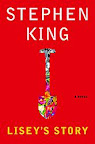
    Lisey's Story: Dewey's review

    Cross-posted at my blog.

    Title, author, and date of book? Lisey's Story, Stephen King, 2006

    Genre: fiction, nonfiction, memoir, history, etc.? Fiction. King generally writes horror, and there are aspects of that in this book, as well as thriller and fantasy.

    What made you want to read it? Did it live up to your expectations? I generally read everything new that King publishes. No, it didn't really live up to my expectations. Since this was chosen as a New York Times Notable Book, I expected it to be one of the best King novels. It's about average on my personal spectrum of King novels.

    Summarize the book without giving away the ending. The main character, Lisey, is the widow of a famous writer. She's grieving as well as trying to process some of what she knows about her husband and his past, and trying to deal with an ill sister, and trying to deal with a deranged stalker.

    What did you think of the main character? I thought she was very strong; she's one those quiet women you may not notice, but if you get to know them, you realize they're intelligent and strong as hell.

    Which character could you relate to best, and why? I didn't relate to any of the characters. The main character, Lisey, has 20 million dollars, a dead husband and several sisters. She's the youngest in her family and she's never had a career. The only thing I really have in common with her is that I know what it's like to travel so much that it's not even fun any more. Her sister, Amanda, is catatonic through most of the novel, so it's hard to identify with her. I certainly don't identify with a male Pulitzer/NBA winning novelist. And most of all, I don't identify with a deranged, violent stalker.

    Were there any other especially interesting characters? The dead writer has a father and brother that we meet through flashbacks to his childhood. They were some of the most interesting characters, for me.

    Did you think the characters and their problems were believable? Well, no. But I don't think I'm meant to. There is another world that the characters visit in a vaguely Narnia-like way. Those who can visit that world have amazing healing powers.

    From whose point of view is the story told? Lisey's.

    Was location important to the story? There are a lot of references to King's fictional places in Maine. For details on those connections, click here.

    Was the time period important to the story? It seemed more like current technology interfered with the story. For example, in order to make some of the isolation Lisey experiences more plausible, she had to be completely clueless about her own cell phone.

    Was the story told chronologically? Was there foreshadowing? No, it wasn't told chronologically. There were a lot of flashbacks, both to the time that Scott (Lisey's husband) was alive and to Scott's and Lisey's childhoods. Yes, there was some foreshadowing.

    Did you think the story was funny, sad, touching, disturbing, moving? It wasn't as sad and disturbing as it was probably meant to be. I think a stronger sense of grief was required from Lisey, whereas there was really more a problem-solving air about her.

    What did you like most about the book? As always, I enjoyed King's wordplay.

    What did you like least? The disgusting scenes featuring the violent stalker. But I think they were meant to be that disgusting.

    Share a quote from the book. A "long boy" is a sort of monster from the alternate world the characters travel to.


    Her own fear is so great it's incapacitating, and any sense of exhilaration at having him back is gone. Has he lived with this all his life? If so, how has he lived with it? But even now, in the extremity of her terror, she supposes she knows. Two things have tied him to the earth and saved him from the long boy. His writing is one. The other has a waist he an put his arms around and an ear into which he can whisper.


    Share a favorite scene from the book. I have two favorite scenes.

    In the first, Lisey and Scott are spending a winter in Germany. King did a wonderful job evoking the sense of despair and desperate homesickness the two experienced. I also like how this scene captured the way in which the mental anguish of one person in a couple can be contagious for the other.

    I also enjoyed the flashbacks to Scott's childhood. King has a gift for characterization, particularly with child characters. The events of Scott's childhood are so horrific, but so real in spite of their basic unreality, that I had to wonder if King himself had lived with a mentally ill parent.

    What about the ending? To be honest, this book really bogged down in the last 1/3 or so. I got to the point where I just wanted to finish. The end contains some writing of Scott's that Lisey found, which gives her a sort of closure. I'm not sure I believe there is such a thing as closure on losing someone you have lived with and loved for 25 years. But Lisey comes as close as she could probably hope for.

    What do you think will be your lasting impression of this book? I think my lasting impression will be "one of the Stephen King books with a female main character." Not one that stands out.

    Thanks to Bonnie for her version of the book review questionnaire.

    Here's an interview with King about this book, though they don't get to discussing this book in particular until halfway through the four minutes. The playful humor you find in King's books is apparent also in this interivew.